Why Ants?
2 Minutes
project update
2026-01-05
Ants communicate in a remarkable way. How exactly does this work, and how can we imitate and utilize it?
Ants communicate and organize themselves in a rather strange way. No sounds that can be overheard and no signals that can be missed. They communicate using chemicals, known as pheromones. What makes this form of communication special is that information does not exist on its own, but is instead bound to a location. And it is exactly this property that can be used to approximate paths programmatically.
How do ants organize themselves in more detail?
In a wide variety of situations, ants release so-called pheromones. As described above, these pheromones contain information in addition to their location. If, for example, a scout ant encounters danger, it releases an Alarm-Pheromone, which prevents other ants from entering that location when they sense it. Besides this obvious warning function, ants also use pheromones to find paths (which we can, of course, perfectly take inspiration from).
The natural pathfinding algorithm
How exactly does path organization work in ants?
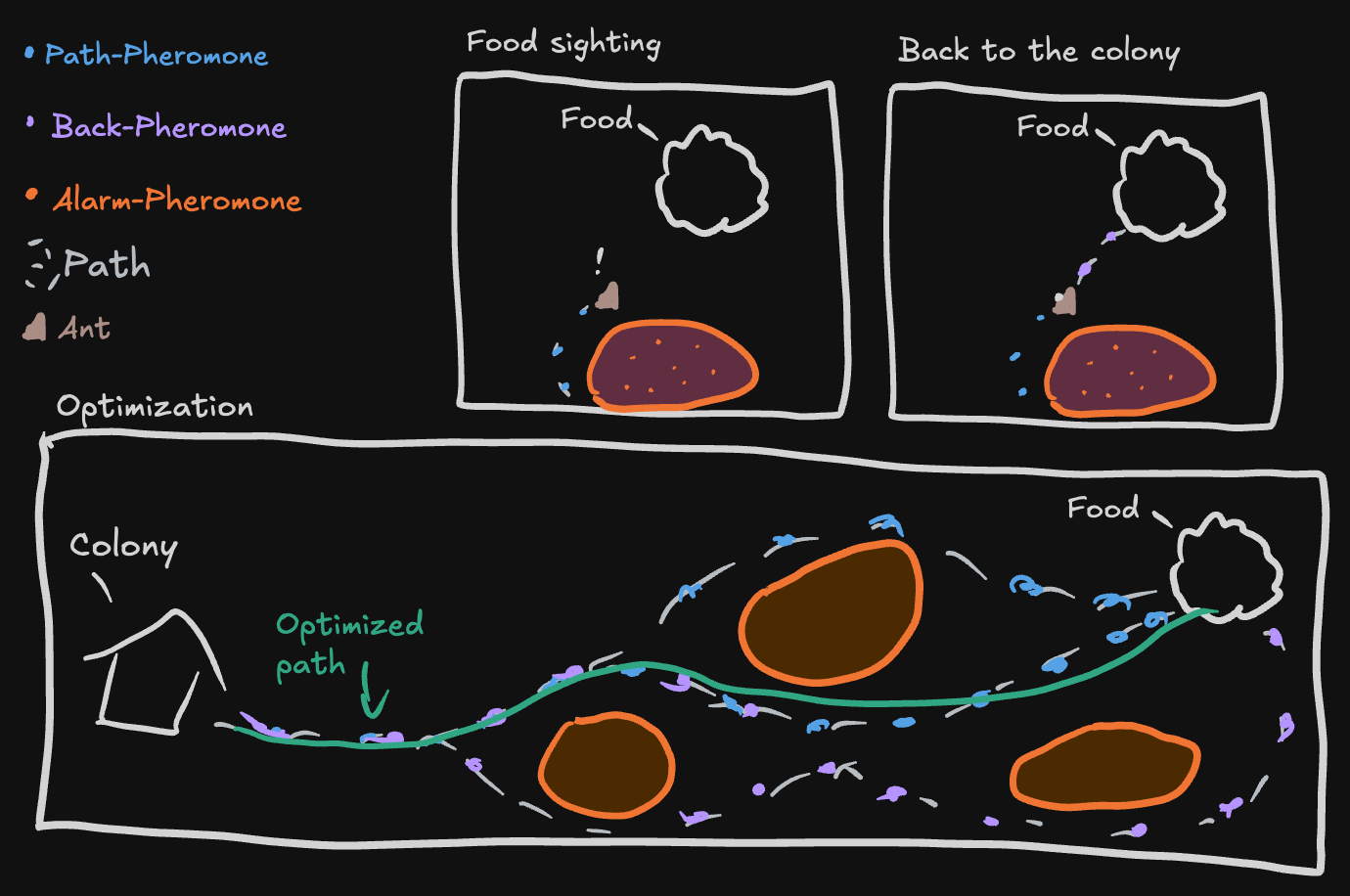
Phase 1: Food discovery
A scout ant goes out in search of food and finds some. During this daring mission, the scout ant lays down a lifeline back home. This is marked here as a blue Path-Pheromone.
Phase 2: Return to the colony
After identifying the food source, the scout ant begins its journey back to the colony. It does so by following the previously placed Path-Pheromones. While doing so, it lays down Back-Pheromones.
Optimization
Now ants travel along this path to transport food back to the colony. They follow previously laid pheromones and avoid Alarm-Pheromones. Non-scout ants also release corresponding pheromones, creating an optimization effect through the sheer number of ants involved. On paths that ants do not use, pheromones fade away, ensuring that these unused paths remain unused. This path will not necessarily be the fastest, safest, or most efficient in every single scenario. However, due to the aforementioned sheer mass of ants, it becomes a reliable all-round solution.
Applications of this idea
As mentioned above, this ant-generated path acts as an all-rounder. In addition, the generation of this path can take many factors into account.
Take flight routes as an example. Here, not only the pure path must be considered, but also the load on this path caused by other flight movements, or the workload of the respective controllers. Other algorithms would need to be executed multiple times to account for all these aspects, or are simply designed to optimize only a single factor. Ant-based approaches, on the other hand, can incorporate complex aspects into path calculation through cleverly placed pheromones and their dynamic adjustment.
Thanks for reading!